UNIT 7 HAVE GOT NEGATIVE
Verb to have got. Presente verbo to have got (tener) negativa
Telling the time / decir la hora(formato digital)
MATERIAL EXTRA
Daily Routine / rutinas diarias
17.- NEGATIVA DEL VERBO TO HAVE GOT (tener poseer algo)
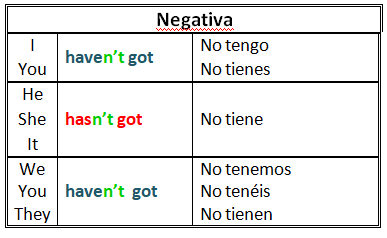
En la tabla tienes la forma negativa contracta del verbo to have got también se puede escribir sin contraer, pero no la vamos a usar en estos ejercicios. Lo habitual es usar la forma contracta en el lenguaje oral por simple economía lingüística. (Decir las cosas en menos tiempo) La forma completa se usa principalmente en textos escritos formales.
En este enlace puedes escuchar y practicar el verbo have got en forma negativa
En estos enlaces puedes practicar el verbo HAVE GOT (negativa)
Ejercicio 25
Escribe las contracciones, mira el ejemplo
I have not got – I haven’t got
a.- We have not got __________________
b.- She has not got_________________
c.- They have not got_________________
d.- You have not got____________________
e.- It has not got________________
Ejercicio 26
Escribe oraciones negativas, mira el ejemplo
I / a pencil – I haven’t got a pencil
a.- Mark/ a brother_______________________________________
b.- My cousin / two black radios____________________________
c.- We /a pink car _______________________________________
d.- Walter and Carol / new passports________________________
e.- You/ blue eyes________________________________________
Ejercicio 27
Escribe frases con esta información.
Martin + a blue credit card (yes) > Martin’s got a blue credit card
We + 7 cousins (no) > We haven’t got seven cousins
a.- Carol + a sister (no) >
b.- Susan and Sam + a new car (yes) >
c.- Your grandparents + 5 grandchildren (no) >
d.- I + 3children (yes) >
e.- It + 4 red flowers (no) >
18.- Telling the time / decir la hora
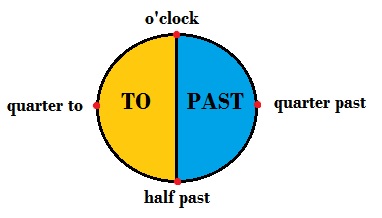
Vamos a ver la forma digital de decir la hora.
What’s the time? / What time is it? > ¿Qué hora es?
1:00 > It’s one o’clock
2:15 > It’s quarter past two / two fifteen
3: 20 > It’s three twenty
4:30 > It’s half past four / four thirty
5:40 > It’s five forty
6: 45 > It’s quarter to seven / six forty-five
7: 53> It’s seven fifty-three
Usamos AT para decir a qué hora hacemos o sucede algo
The shops close at nine o’clock > Las tiendas cierran a las 9:00
We cook dinner at eight thirty-three > Hacemos la cena a las 8:33
Ejercicio 28
¿Qué hora es? / What time is it? Escribe las horas, mira los ejemplos.
7:45 > It’s seven forty-five / It’s quarter to eight
5:16 > It’s five sixteen
a.- 2:46 >
b.- 12:15 >
c.- 3:33 >
d.- 7:18 >
e.- 10:51 >
Ejercicio 29
Esta es la rutina diaria de lunes a viernes de Robert and Rose, completa el texto utilizando la tabla.
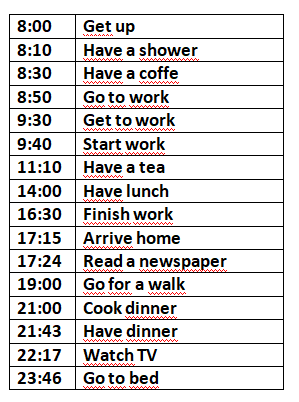
Robert and Rose get up at eight o’clock. They have a shower at eight ten. They have a coffee at half past eight…
_______________________________________________________________________________________________________________________
_________________________________________________________________________________________________________________________
_________________________________________________________________________________________________________________________
_________________________________________________________________________________________________________________________
MATERIAL EXTRA
DAILY ROUTINES / RUTINA DIARIAS
wake up > despertarse
get up > levantarse
have a shower / take a shower > ducharse
have a bath / take a bath> bañarse
get dressed > vestirse
have breakfast > desayunar
have lunch > comer
have dinner > cenar
go to work / school > ir al trabajo/colegio
get to work /school > llegar al trabajo/ colegio
start work/ classes > empezar a trabajar/ las clases
have a break > tomar un descanso
have a coffee/ tea > tomar un café / té
finish work /clases > acabar el trabajo/ las clases
go home > ir a casa
arrive home / get home > llegar a casa
go for a walk > ir de paseo
go to the gym > ir al gimnasio
go shopping > ir de compras
visit friends > visitar amigos/as
cook breakfast /lunch / dinner > cocinar el desayuno/comida/cena
read a newspaper/ book / magazine > leer el periódico, libro, revista
listen to music > escuchar música
watch TV > ver la tele
go to bed > ir a la cama
sleep > dormir
En este video practicarás el vocabulario de las rutinas diarias